.png)
Opening April 28, 2026
Galeria Estação
R. Ferreira de Araújo, 625 - Pinheiros, São Paulo - SP
Artist

Meeting Navegante was a moment that reminded me that the creation of something new, something truly different can still emerge from anywhere.
With the rise of social media and the widespread use of mobile phones, everyone, literally everyone now produces, receives, and circulates an immense volume of information, including self-taught artists from remote and sparsely populated places. I found myself wondering whether this diminishes the possibility of still encountering purity, originality, and spontaneous beauty.
Yet, when I met Navegante, who was introduced to me by Pedro, a gallerist from Ceará, my faith was restored. An Indigenous artist born in Ceará, she creates her work using natural pigments extracted from the tiny cavities left behind by the ciés, small crustaceans, as they move through their environment.
I won’t say more. Instead, I invite you to see Navegante Tremembé’s first exhibition in São Paulo and to be as captivated by her work as I was.
VILMA EID

The Age of Color
Navegante Tremembé was born in 1960 in the Indigenous village of Varjota, located in Itarema, in the hinterland of the state of Ceará, Brazil. In her youth, her neighbor Maria Rosa Tremembé taught her the ancestral Indigenous technique of toá, a natural pigment traditionally used to paint architectural surfaces, as well as paper, canvas, and ceramics.
Toá is a colored sand that Navegante gathers from the soil of her ancestral territory, a landscape shaped by the mangrove, the lagoon, and the Aracati-Mirim River. This pigment originates from geological layers formed billions of years ago, during periods such as the Paleozoic, Mesozoic, Cenozoic, and Holocene, among others. Composed through a combination of chemical elements that include iron oxide, kaolin, and silica, these layers resulted in sediments of varying colors. As such, toá is naturally found in yellow, red, and white, which constitute its primary colors. From these, and with the addition of mineral charcoal powder, the artist creates her secondary palette: orange, green, and blue.
The making of Navegante’s paintings begins before the canvas. It starts with the gathering of toá within her Indigenous territory. With the help of the cié, a small mangrove crustacean, the artist can locate the pigment in the soil, establishing an interspecies relationship between Indigenous humanity, animal life, and geology. Every stage of the process is part of the work: from the attentive reading of the landscape’s signs to excavation, the selection of sediments, washing, decanting, and the preparation of the paint. Her process is an alchemy that combines complex technique with ancestral knowledge passed down through generations.
Following the death of Maria Rosa Tremembé, Navegante is now the last person in her village who retains knowledge of the toá technique, becoming the guardian of the ancestral wisdom of the Tremembé people. Archaeologist Marcélia Marques has conducted extensive research on Navegante’s territory and argues that the survival of toá today is one of the most compelling forms of evidence in the ongoing struggle for the demarcation of Tremembé Indigenous land.
Today, Navegante’s ancestral territory is under dispute by monoculture enterprises and organized groups that have cleared trees and erected fences around the mangrove, reshaping the landscape under the pressures of neoliberal capitalism. This environmental devastation has led to the destruction of local flora and fauna, from the extinction of native trees and plants to the disappearance of birds and other animals. In her paintings, Navegante depicts these trees and birds as an act of denouncement against coloniality. Her work is therefore political: it records, preserves, and renders eternal that which is on the verge of disappearance.
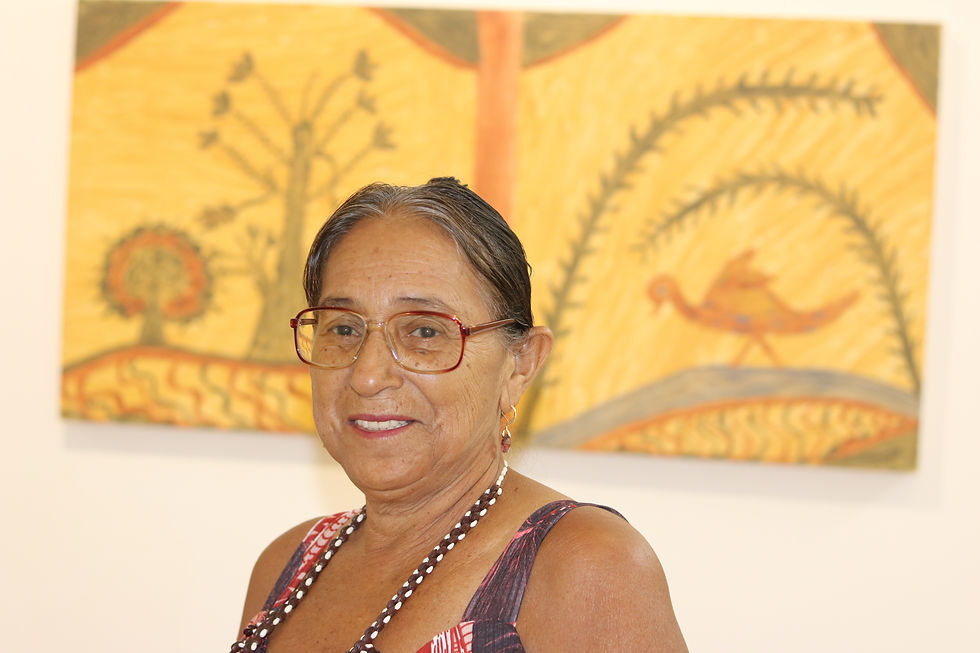
Her canvases bring together personal experience, Tremembé cosmology, memory, and imagination, forming dreamlike compositions characterized by synthetic figuration, an economy of space, and an Indigenous geometry. Her figures are imbued with movement, expressing the vital, pulsating force of Nature. The abstract and geometric areas within her paintings point to the spiritual dimension of Tremembé culture. Thus, Navegante’s painting is not merely a reproduction of the toá technique, but rather a continuous process of experimentation and reinvention of tradition.
The material of toá, formed long before humanity, carries ancient memories of the planet; it is an archaeological relic from a time before the colonizing presence of humankind. For this reason, her paintings function as archives of the Earth, preserving knowledge and mysteries that may guide us toward alternatives in the face of climate collapse and environmental crisis. In her work, we do not encounter the predatory presence of humans, but rather the freedom of the landscape, where diverse forms of life are interconnected within an intimate ecology. Her painting suspends time, transporting us to a past before humanity or to a future in a state of regeneration.
Lucas Dilacerda
Curator, AICA – International Association of Art Critics


About the artist
Navegante Tremembé
Navegante Tremembé is an Indigenous artist from the Varjota village in Ceará, Brazil, whose practice is rooted in ancestral knowledge transmitted within her community. For over four decades, she has produced paintings using toá, a traditional technique that employs natural pigments extracted directly from the earth. This process establishes a direct relationship between material, memory, and territory, shaping a visual language deeply connected to Tremembé cosmology.
Her work brings together painting, memory, and resistance, transforming artistic practice into a means of preserving knowledge. The toá—colored earth formed through ancient geological processes—embodies an expanded sense of time, allowing her paintings to function as true archives of the land. Through this material, she combines personal experience, imagination, and cosmological references to create synthetic landscapes marked by formal economy, rhythm, and a distinct Indigenous geometry.
Trees, birds, and elements of the natural world appear as recurring motifs in her compositions, evoking both the vitality of nature and its vulnerability in the face of extractive practices. Her work thus takes on a political dimension, documenting and preserving what is at risk of disappearance while articulating both resistance and continuity.
Navegante Tremembé’s work has gained recognition for its symbolic strength and contemporary relevance, and is included in institutional collections such as the Museum of African Contemporary Art Al Maaden (MACAAL), in Marrakech.
Her trajectory affirms the power of a practice that brings together territory, ancestry, and visual language, positioning her work as one of the most singular and urgent voices in contemporary Indigenous art in Brazil.
"In her work, we do not encounter the predatory presence of humans, but rather the freedom of the landscape, where diverse forms of life are interconnected within an intimate ecology. Her painting suspends time, transporting us to a past before humanity or to a future in a state of regeneration."


Memories of the earth | Navegante Tremembé
Opening: April 28th at 6pm
Address: 625 Ferreira Araújo St. - Pinheiros, São Paulo
Gallery Hours: Monday to Friday, 11 AM – 7 PM; Saturdays, 11 AM – 3 PM; closed on Sundays.
Phone: +55 11 3813-7253 | +55 11 92164-4695
Directors
Vilma Eid
Roberto Eid Philipp
Curator
Lucas DiLacerda
Art Historian
José Augusto Ribeiro
Commercial Director
Giselli Gumiero
Sales
Alyne Shiohama
Production
Amanda Clozel
Marketing Director
Luciana Baptista Philipp
Marketing Agency
Zion Branding
Photos
Pedro Bessa
Assembly
Cadu Pimentel
Lighting and production support
Marcos Vinícius dos Santos
Kléber José Azevedo
Diogo Gabriel Leite Santos
Press
Baobá Comunicação, Cultura e Conteúdo
Revision
Otacílio Nunes
Translation
Maria Fernanda Mazzuco - Inglês
Printing and finishing
Romus Indústria Gráfica